WITH HALLMARK MOVIES RUNNING 24/7, IT’S CLEARLY TIME FOR OUR HOLIDAY DEBATE: ACP EDITION!

So…the turkey is eaten and Black Friday is in the books. No doubt about it, the holidays are here — and with them comes a modern-day twist on a question that haunts mankind, and will serve as our guiding query for the next few weeks: Given our 24/7 news cycle, the rise of social media and the ubiquitous nature of cell phones, can there be peace on earth?
December 4-19 (A)/20(B): The Big Holiday Debate
During your first class, of the week of 12/5, I’ll assign your team to either the “Yes, There Can Be Peace on Earth ” Team or “No, There Can Be No Peace” side of the debate. Then, working with your team, you’ll build your research-supported primary case answering this burning seasonal question, with several key deliverables, listed below. Finally, you’ll debate for your ACP grade.
The requirements?
- First, we’ll present our Swift projects in class on Wednesday, 11.30(A)/Thursday, 12.1(B). Here’s the Google form you’ll need to analyze your peers’ work; you need to complete the form 2 times for 2 different presentations to receive credit for your peer reviews.
- Now, to the debate! Your group’s case must comprise the complete Aristotelian argument and all of Townsel’s required writing elements.
- You’ll also need to include as a group specific evidence from at least 15 separate, credible sources — all of which must be tabled and cited by your team as you deliver your primary case; included in a formal, MLA 9 “Works Cited” slide(s) (here’s an example with instructions); and also delivered to me as a group in an organized research table. And your sources MUST include evidence from and/or references to Frankel and Kang’s An Ugly Truth, your notes from the documentary “The Social Dilemma,” and this article about turning off your cell phone over the holidays, which you will rhetorically analyze, using SPACE CAT (due INDIVIDUALLY by 12.5 (AO/12.6 (B).
- You’ll work as a team to create an attractive Google Docs slide presentation to screen share as you present your case, with your “Works Cited” page provided at the end. DO NOT WRITE AN ESSAY AND THROW IT INTO FIVE UGLY, OVERCROWDED SLIDES: Make your deck clean and professional, and use speaker notes and practice to deliver your argument effectively.
- Your slides are due, submitted to this Google folder, by midnight Thursdqy, 12.15, no matter which day you debate — AND your research tables are due to this Google folder by midnight Thursday, 12.15, no matter which day you debate. Finally, make sure you’ve set your share settings appropriately so you can access your work when it’s time to debate.
- You’ll PRESENT your case, not read it verbatim. This means that, without a doubt, every member of your team will need to practice your delivery BEFORE debate day.
- Everyone on each team must have a significant role in the debate — everyone must research, write, and deliver your primary and/or participate in cross-examination. In the end, you’ll be completing for a grade this Google self-reflection form outlining your specific role in brainstorming, creating, research, delivering and defending your primary case.
- Your debate needs to fill an 8-minute primary case allotment, and we’ll be STRICTLY observing our Pumpkin Debate rules: primary cases, three-minute cross-examination allotments, and one-minute summations and rebuttals. TIME YOUR WORK. This time, going significantly short or long will have an impact on your team’s score.
- As your last step, in addition to the Google self-reflection form, you’ll write an essay (minimum of 750 words — roughly the front and back of one piece of notebook paper minimum) arguing for the OTHER side of the debate — so, if you’re a Team Yes debater, you’ll write a Team No essay. You’ll turn that hand-written essay in to me in class on debate day, along with your three-row AP argumentative rubric self-score and your rhetorical analysis of the holiday stress articles.

Holiday Debate/Essay Rubrics:
“Other Side” Essay: 100 points possible under 6-point AP Argumentative Rubric (so READ that rubric before you start). Pointers:
- Writing is effective and persuasive
- Argument is well-supported, with a CLEAR line of reasoning and appropriate evidence
- All parts of the Aristotelian argument represented
- All required writing elements included
- Due on the day of your debate.
Class Debate: 100 points possible
- Debate is PRESENTED and not simply read: 20 points possible
- All nine parts of the Aristotelian argument present and effective in both the charted argument AND the debate as delivered: 30 points possible
- All three Aristotelian argumentative appeals — ethos, logos and pathos — are in clear evidence: 10 points possible
- Argument is supported with at least 15 credible sources: 15 points possible
- Primary case makes effective use of the allotted time: 10 points possible
- Cross-examination makes effective use of the allotted time: 5 points possible
- All members of the team participate well: 10 points possible
Your first step? By 10 p.m. of the day of your first class of the week of 11.29-12.3, read this blog post in entirety, then comment below indicating your understanding and acceptance of this project, including all requirements.
And with that, let the holiday games begin!

Drawing Holiday Inspiration From Those Delicious, Delicious Babies: DEADLINE Dec. 2 (A)/ 3(B)
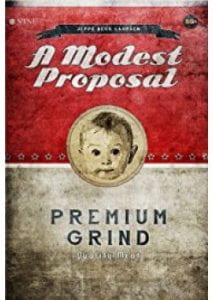 As we’ll discuss in class, most scholars consider Jonathan Swift’s “A Modest Proposal For Preventing the Children of Poor People in Ireland from Being a Burden to Their Parents or Country, and for Making Them Beneficial to the Public” (1729) to be the most brilliant satire ever written, addressing as it does the injustices the English had heaped upon the poor Irish — in particular, poor Irish catholics — for centuries. In the nearly 300 years since its publication, “A Modest Proposal” has inspired countless films (including this short offering out of Norway, numerous rock songs and a rap version) and, last year, served as the subject of a BBC podcast that should listen to at least the first 10 or so minutes of before you engage in your project work this week.
A complete and extremely effective Aristotelian argument, Swift’s satirical work still looms large, regularly making its way into modern-day political headlines — most notably, perhaps, a decade or so ago when Republican House Speaker Newt Gingrich suggested that schools could save money by replacing their custodial staffs with their poorest students. The quintessential example of Juvenalian satire, Swift’s hyperbolic essay suggests that the impoverished Irish might ease their economic troubles by selling their children as food to rich gentlemen and ladies — in the process mocking heartless attitudes towards the poor as well as British policy toward the Irish in general. Published anonymously, “A Modest Proposal” sparked outrage in England and Ireland by readers who failed to appreciate his satiric intent — and at least one of his contemporaries turned the tables, suggesting that the proposal would be a way he could alleviate a debt he owed Swift.
Between now and right after Thanksgiving, we’ll be analyzing Swift’s essay, and you’ll work — either solo or with a group of your choosing — to make a commercial or advertising poster inspired by Swift’s classic satiric essay.

The Assignment, Due AT THE START OF CLASS ON MONDAY, DECEMBER 2 (A Day) or TUESDAY, DEC. 3(B DAY):
FIRST: Click through and read and watch all the materials linked in this post, above. “A Modest Proposal” is an essential part of our Western canon of literature, so you’ll want to understand it completely. It WILL come up again in college English, history and economics classes.
SECOND: Select a group of up to 3 partners (for a total of no more than 4) — or opt to work alone if you prefer — on a video commercial or electronic poster for a product, idea, or social concept inspired by Swift’s essay. Opt for the commercial, and you’ll need to upload your work to YouTube, make it viewable so I can take a look, and provide me with a link when you’re done; opt for an electronic poster, and you’ll create your work in Canva,then share it with me.
Some things to consider as you decide how you’ll work and who you’ll work with:
- Carefully consider your plan. Make sure you can work with the people you choose. Pick an unreliable friend, and you’ll be stuck with the lion’s share of the work. Elect to work alone, and you may end up feeling a bit overwhelmed.
- There’s no need to include yourself or members of your group in the video you create; you can collaborate remotely using video shot separately, stock footage, stock sound, etc. — but you ALL need to contribute equally to the final effort.
- As you commit to a plan, IMMEDIATELY set up your systems for communicating and collaborating.
Your requirements for either deliverable, DUE AT THE START OF CLASS ON DECEMBER 2 (A Day) or DEC. 3 (B DAY):
- In a single comment per group at the bottom of this post, list the names — properly spelled and capitalized — of all members of your group, or tell me that you’ll be working alone. If you elect to work in a group, everyone in your group must participate equally and be able to explain their specific role in the project.
- Your project must be CLEARLY inspired by Swift’s satire in an immediately obvious way.
- Your submission MUST include every part of the Aristotelian argument — and every one of Townsel’s required writing elements — to persuade your audience to do something specific — for example, buy a product, support a cause, join a group. It’s up to you, but from exordium to peroration, appositive phrase to power sandwich, ethos to pathos, it all needs to be there.
- If you use graphics, video, sound our sources that aren’t your own work, you need to credit every bit of what isn’t you or your group’s original work or brainwave in a Works Cited page on the back of your poster or in your video.
- Taking pains to publicly post your work and/or enable all share settings, submit either your/your group’s actual work or the link to your group’s work to this Google folder.
Submit, and you’ll be living large...unlike our small friend, below…
