SEPTEMBER 28-OCTOBER 4: DYSTOPIA, LINE OF REASONING, AND THE INTERSECTION THEREOF (DEADLINE FOR ALL WORK 10 P.M. SUNDAY, 10.4.20)
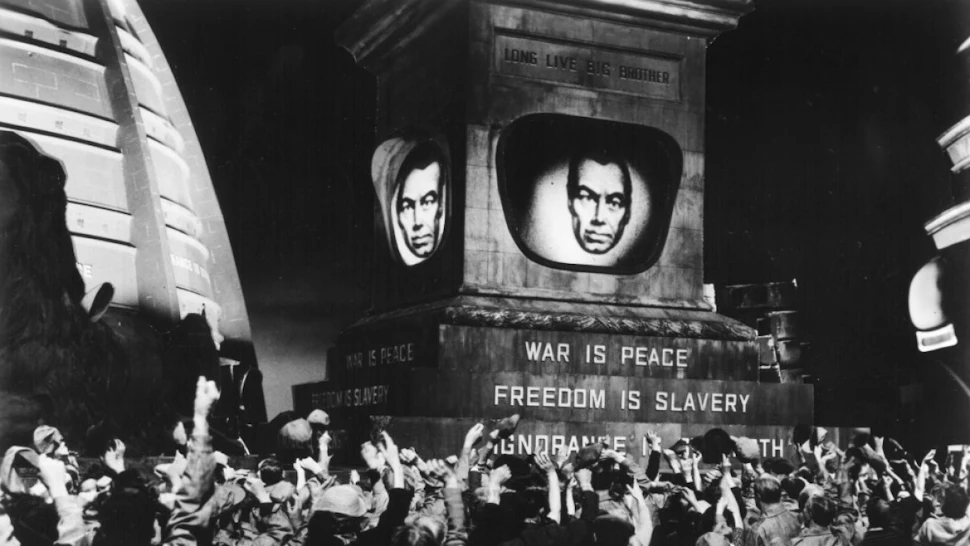
 And so, the grind begins. Another week, another opportunity to work with line of reasoning (a.k.a. LOR) — this time, in a video that accompanies a Wall Street Journal opinion article arguing that we here in 2020 are surrounded by Orwellian Newspeak — and in a letter the editorial references, a university-focused variation on cancel culture. Unfortunately, the article is behind a paywall I’m unable to navigate for our group, so you’ll just be able to watch the video featured at the top of the link and read the referenced letter.
You’ll also work with the line of reasoning in a gaming article, which makes an argument about yet another dystopian world — this time, the universe that informs the game The Outer Worlds. And for good measure, the line of reasoning in the Outer Worlds song The Fine Print (you’ll find the lyrics here, but watch the video a few times to help you get ready to conduct the CAT of SPACE CAT analysis).

As we wrap up September, though, we’re stepping up the pace here on our factory floor: you won’t just be analyzing for line of reasoning, you will — just like the oppressed shift workers in Fritz Lang’s cinematic masterpiece “Metropolis” — be employing your Malala LOR format to create a line of reasoning for your own original argument.
This Week’s Work
a) Let’s start by revisiting the peer comments you received on your précis on last week’s post. Keeping in mind our goal of intentionality — of intentionally pursuing excellence in all we do — revisit your work and see if there are any improvements you can make. A few hints: some of you failed to follow the four-sentence format, more than a few of you avoided using rhetorically accurate verbs, and many of you could benefit from streamlining your language. So, once again, drop the mic: revisit your precis with a view to improving you work, and post your best and final as a comment, below. Per usual, make sure you include your name — last name first, first name last — at at the top of the post. Pro tip: Revisit the sample I linked in last week’s blog to make sure you’re hitting on all cylinders.
b) Watch the video at the top of Wall Street Journal article, then use the Malala format you worked with last week to identify and outline the line of reasoning in the video only. Remember as you work to take a look at those rhetorically accurate verbs and put them to work! Then, read the gaming article and analyze its line of reasoning as well. When you’re done, turn your work on both lines of reasoning in here. Pro tip: Create your work in word or Google, then cut and paste your efforts into the form. That way, you retain a copy of your work — and you might just need it again.
c) Watch this video on rhetorical choices, then use the SPACE CAT analysis formula to analyze Stupendium’s song “The Fine Print” — paying particular attention to the CAT portion of this approach: choices, appeals and tone.You’ll need this work for class at the start of class on Thursday, 10.1 (A)/Friday, 10.2 (B). Watch this video if you need more information on SPACE CAT.
d) For weeks now, you’ve been steeping in a dystopian world of hard labor, thought control and doublespeak. Employing evidence from Orwell’s 1984 and the readings and videos in the first few weeks of this course, create a line-of-reasoning outline for an essay you will write next week addressing the prompt: Is our technology taking us closer to the world of Big Brother? When your line of reasoning is ready, hit Flipgrid (that’s the join code right there in the link) and present your work!
We’re off to the races. Keep on keeping on!
SEPTEMBER 21-27: OF ORWELL, SOCIAL MEDIA, SPACE CAT, AND LINE OF REASONING (DEADLINE FOR ALL WORK 10 P.M. SUNDAY, 9.27.20)
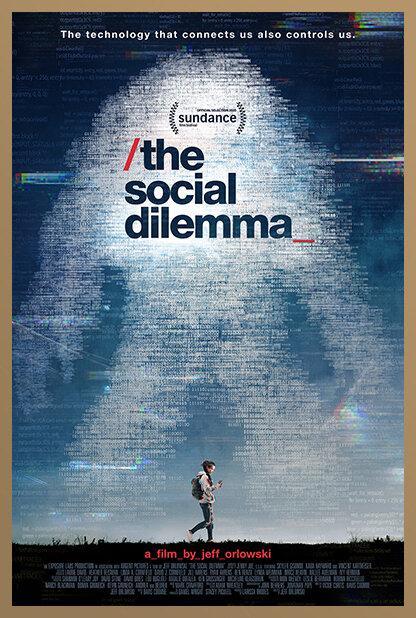
If you’re lucky enough to have access to a Netflix account, odds are you’ve seen or heard about the 2020 documentary The Social Dilemma. If you haven’t, check it out if you can gain access. It’s a terrifying look at the damage social media and search engines inflict daily on people of all ages but, particularly, pre-teens and teens. As I watched it over the weekend, it kept bringing to mind an older video — an interview with business expert and author Simon Sinek — wherein he describes the “trouble with millennials” in the workplace. Both The Social Dilemma documentary and Sinek make solid arguments about the negative role technology addiction and its associated hit of dopamine play in eroding social norms and creating ever larger gaps between us — a message Fast Company echoes compellingly. Orwell’s dystopian vision resonates (reverberates?) here in 2020, 71 years after its date of publication and 36 years after its eponymous setting.
In this third week of AP Language, we’re going to focus on the rhetorical situations that inform each of the videos and texts linked above, and on the line of reasoning each employs in making and supporting an argument. We’ll talk about the rhetorical situation in our Zoom class this week, talk about using an approach called SPACE CAT to identify and analyze its key elements, and then we’ll talk about the “skeleton” of an argument, which is any author’s line of reasoning.
 This Week’s Assignments:
a) You just completed your four-sentence rhetorical précis for last week’s assignments. Please post it as a comment below — and, then, wait until the end of the week. After a few days, come back here, read your peers’ work, and provide constructive criticism and suggested edits to at least three classmates. Pro tips: Consider starting at the bottom of the comments and work your way up as you’re providing feedback — and make sure every précis posted has at least one peer response before you leave second responses. Share the love!
b) Once you’ve posted your précis, and watched the line of reasoning video (also linked above), read and complete this lesson on line of reasoning. Note: I’ve given you the teacher copy of this lesson so you can read your way through it since we can’t meet synchronously this week. For now, skip reading the supplied answers and answer the BLANK form, which is a PDF, so you can either print and complete the sheet by hand; use an app to convert it to an editable PDF and complete it in the actual form or, my preference, copy the questions into a Word document and answer the questions in there. Use the Malala speech included in the handout: you’ll need it both this week and next. When you’re done, and only when you’re done, review what you’ve written against the supplied analysis and, where necessary, make adjustments in your work. And, remember to be intentional. Do your best. You absolutely will be turning your efforts in to me during a near-term class.
c) If you haven’t yet, click on all the hyperlinks, above, and read or watch them all. We’ll watch some and talk about them in class, but our time is necessarily limited, so it’s up to you to watch carefully independently so you can complete the week’s written work. Once you’ve read and watched everything, start with the Sinek video, in which he makes a compelling, but controversial, argument. Outline his argument, using the same format you used in the lesson in assignment (b), above — and be clear and specific in what you write down When you’re done with your outline, select what you consider to be the most interesting of the news articles I linked to, above, and complete the SPACE component of SPACE CAT analysis for the article you select. Final step: cut and paste your Sinek line of reasoning outline and your SPACE analysis into this Google form.
We’ll briefly meet on Zoom at the beginning of your scheduled class time this week unless MAPS testing interferes. I’ll keep you posted via Remind. Finally, no matter what happens with testing and this week’s weird scheduled, I’m always available to you after Zoom during regularly scheduled class meetings and during live office hours on Wednesdays. Zoom in if you have questions, of course, but consider dropping in just to have company while you work or to ensure some accountability. I’m happy to help you out in any way you need in this strange online environment, even if it’s just to help you stave off procrastination. Remember…

SEPTEMBER 14-20: THE FACE OF INTENTIONALITY (DEADLINE FOR ALL WORK 10 P.M. SUNDAY, 9.20.20)
 Last week, we begin talking about one of the most important elements of this class, of your life as an artist, as a college student, in your life in general: intentionality. Simply put, intentionality means approaching everything you do with a sense of purpose — but as the link amply illustrates, being purposive, being decisive in all that you do is really something of a life philosophy. In your first class of this week, we’ll talk about intentionality, and we’ll take a look at Facebook’s intentionality in its early April COVID-19 commercial, and we’ll briefly discuss the Kate Tempestt spoken-word piece Facebook employs in its video. (I’ll save that discussion for our Zoom call.) We’ll also spend some time talking about Facebook’s goal for the piece. Could this be it? We’ll discuss the rhetorical situation that underlies the piece, and then use that — and a bit of Orwell’s 1984 — as a springboard to talk about intentionality as an underpinning AP Language philosophy.
When we’re done discussing Facebook’s (perhaps two-faced) purpose for that particular piece of commercial speech, I’d like you to revisit your comment on our last class blog through the lens of your newfound focus on intentionality; further consider Orwell’s rhetorical situation and the intentionality of his inclusion of Newspeak in 1984; and capture your thoughts in a rhetorical précis take a reading quiz on his game-changing dystopian novel. So, with all that said…

This week’s assignments
1) Revisit your comment on last week’s blog, where you were asked to write two well-developed, 6-8 sentence paragraphs employing Newspeak. As you review your work, thinking about our class discussion about intentionality, ask yourself the following questions: Did I truly employ Newspeak in my responses, or did I drop in a word or two without being true to its rhetorical structure as described by Orwell? Are my paragraphs meaty enough to truly cover each question? Did I observe appropriate spelling, punctuation and grammatical conventions? Bottom line: Was. I. Intentional? When you’re done examining your work, revise it to ensure that you are being purposive, you are being intentional, you are being thorough, and you are being fully honest with yourself that this truly is your best work — and then post your best and final response as a comment, below for a quality grade. You may find it helps to click through that link I provided you in the paragraph above about Newspeak as you finalize your response.
2) Go to Socrative, join code teamtownsel, and take the reading quiz for 1984. Make sure to include your name — last name first, first name last (i.e. Townsel, Melody) — and plan on spending an hour or so for this assignment; it’s a written exam, so it will take some time — and you’ll need to have your copy of 1984 on hand as you take the quiz.
3) When you’re done, give yourself a break for a day or so and, then, grab your copy of 1984 and, then, using the formula you’ll find here, and in the picture of the chart, write a four-sentence rhetorical précis about Orwell’s intentionality in 1984. As you can see from the link, I’ve provided you both with a fill-in-the-blank formula for writing all four sentences and, through the link, a clear example of what you’re expected to do. When you’re done, click through to this google form and add your work…then bring it to class for some group work early next week.
Be well, stay cool, keep safe, and be intentional. Remember, I’m always available via Remind and by appointment on Work-It Wednesdays, and I’m happy to help you out if you’re struggling with any part of this work. I look forward to reading your work. See you next class!
September 8-13: Back in the Saddle Again! (Deadline for all work 10 p.m. Sunday, 9.13.20)
 Yes, it’s hard to believe…but, after the longest Spring Break in recorded history, we’re Back in the Saddle Again! It’s hard to imagine a movie with better lessons for the school world we’re entering now than “Toy Story.” Change can be tough. Unless you’re truly a hermit, everyone really wants to be a part of a group somehow. What would we do without friends? Who are you really? Because change can be tough, we’re going to use this week to get to shake off the stupor of our long, slow summer, get to know each other a little, get ourselves in the right places at the right times, organize ourselves, and, for the procrastinators among us, finish up the last of the summer work. (Trust me, we’ll be debriefing the work in LearnArgument and unpacking Orwell’s 1984 soon enough.)
Logistics
For the foreseeable future, this class will be run as follows: a 15-minute touchbase meeting via Zoom at the beginning of each period; your work posted here by assignment week with the firm deadline STATED AT THE TOP OF THE ASSIGNMENT, as it is for this one); and your taking advantage of Work-It Wednesdays, asking me questions or seeking tutoring during my live office hours.  Given how crazy this academic year is going to be, I’ll be posting all of my assignments, deadlines, expectations, and hyperlinks to everything you’ll need succeed HERE in this blog. I’ll also send out regular Reminds about new or changing assignments, upcoming deadlines, books you need to obtain for class, jokes, and extra-credit opportunities. AP Language is a challenging course, but if you stick with me, read everything I give you, and do the assignments to the best of your ability, you will be ready for the AP Language exam in May.
This Week’s Assignments:
Since this week is about organization and logging in work for the summer, here are the things you need to accomplish this week:
- If you haven’t yet, complete your assignments on LearnArgument. If you have, there’s no need to send me your certificate, I can see your progress on the system’s dashboard. I’ll be entering grades for your completion of the work at 10 p.m. Sunday, and will enter a missing notation if I don’t have it yet.
- If you haven’t yet, finish reading George Orwell’s 1984 by 10 p.m. Sunday; I’ll put your reading quiz up on Socrative late Sunday evening. (‘ll send out a Remind when I do, and you’ll be required to visit my standing Socrative room, teamtownsel; enter your last name first, first name last EVERY TIME YOU USE SOCRATIVE; and complete and hit submit for your work.)
- If you haven’t yet, a) join my Remind NOW. When you join, be sure to use your COMPLETE last name — and if you’ve already used an initial or a nickname, please fix that now. (It’s challenging to work with last-name initials when trying to track progress and enter grades.)
- If you haven’t yet, b) use the join for your section to create this year’s account in AP Classroom: 1A Code 62E9YY, 2A Code 2ZWY4W, 3B Code N2Y63Q, 4B Code X9RGJ7. If you don’t have a College Board account yet, you’ll need to set one up. If you DO have a College Board account, but you’ve forgotten your username or password, you’ll need to use their username and password recovery functions to get set up for the year. And if you have any challenges recovering your account, you’ll need to call the College Board customer service line at 865-315-6068.
- Once you’ve joined AP Classroom, use your account there to c) register for the AP Language exam. You need to complete this step by 10 p.m. Sunday, 9.13. I’ll be taking a grade for your completion of steps 3-5 here.
- Finally, by our standing weekly homework deadline of 10 p.m. Sunday evenings, please go to the “leave a comment” button at the bottom of this post, use your last name first, first name last, and your class section, and then post the following as your first real regular assignment of the year ahead: Write two descriptive paragraphs (6-8 sentences per paragraph) employing Newspeak to a) describe yourself as a student and b) describe your feelings about 2020. Pro Tip: You DO NOT need to set up an account or a blog, simply comment with the information and work I’ve requested.
- One last thing: If you read 1984 at the beginning of the summer, or in your eighth-grade year, make sure you review the actual text itself between now and next week’s class. You’ll be required to go deeper than names and facts in the summer reading quiz, so you’ll need to be ready to compare characters, address key themes, and do some crossover analysis between the novel and the work you did on LearnArgument. In other works, Sparknotes, Bookrag, and John Green won’t give you what you need to move forward.
I look forward to seeing what you write here, below, and remember…
